Applied Statistics / AI Algorithms
Hi, I'm Jiayi Lu. I turn data into decisions, models, and the occasional aha.

M.S. in Applied Statistics, Shenzhen University · AI Algorithms / Applied ML
Turning statistical intuition into shipped models — LLM pipelines, ensembles, and evaluation harnesses.
About
Turns statistics into models that ship.
I'm Jiayi Lu, an M.S. in Applied Statistics at Shenzhen University, recruiting for Fall 2027. My B.S. was in Building Environment & Energy Engineering; the pivot to statistics and AI in grad school wasn't an accident — I keep returning to the same idea: use statistical intuition to bound the problem, then engineer the model that solves it — and be able to say where it breaks.
I work across two tracks — AI Algorithms and Applied ML: SlayQuiz (LangChain + DeepSeek generation chains with structured output, async retry, and RAG retrieval), Strategem (LangGraph state machines with dual-channel retrieval and evidence-grounded citation), while interning at CICC Wealth's Strategy & Digital Center, working on 600K+ prospect records — profiling, attribution, and A/B experiments.
Research: first-author on an ICME 2026 (CCF-B, 28.89% acceptance) paper (SGT-Aug, long-tailed multi-label classification — accepted, EI indexed by Nov) and a CPCI conference paper (Bagging-ensemble time-series forecasting). Led a team to 3rd prize in the Guangdong regional track of the National Statistical Modeling Contest.
Three questions I keep asking on every project: What's the business problem behind this number? Where are the model's limits? Who's affected when this ships? The site follows the standard portfolio layout — 02 Experience · 03 Projects · 04 Skills — to mirror the résumé.
Experience
Latest internship · reverse-chronological.
-
2026.05 – 2026.09 Intern
Data Analytics Intern @ CICC Wealth · Strategy & Digital Center · Data & AI Agile Team
Profiling & data foundation: processed 600K+ prospect records (80+ business fields) in Python and built a five-dimension prospect-profile framework; established a 7-dimension, 1000+ tag hierarchy as the canonical data layer for precision targeting and the customer-insight agent.
Channel conversion & attribution: analyzed 18 online channels' acquisition efficiency; funnel-matrix analysis isolated 3 critical drop-off points across 6 core channels (peak drop-off ~50%). Attribution analysis surfaced the dominant churn drivers. Proposed a contribution-vs-efficiency 2×2 to reallocate channel budgets and optimize outreach.
Modeling & experiment design: logistic regression + random forest to surface conversion drivers; clustering for prospect segmentation; two-sample hypothesis tests to compare conversion across reach strategies at the same drop-off cohort; designed a stratified A/B framework for differentiated-policy testing.
Selected Work
What can I do?
-
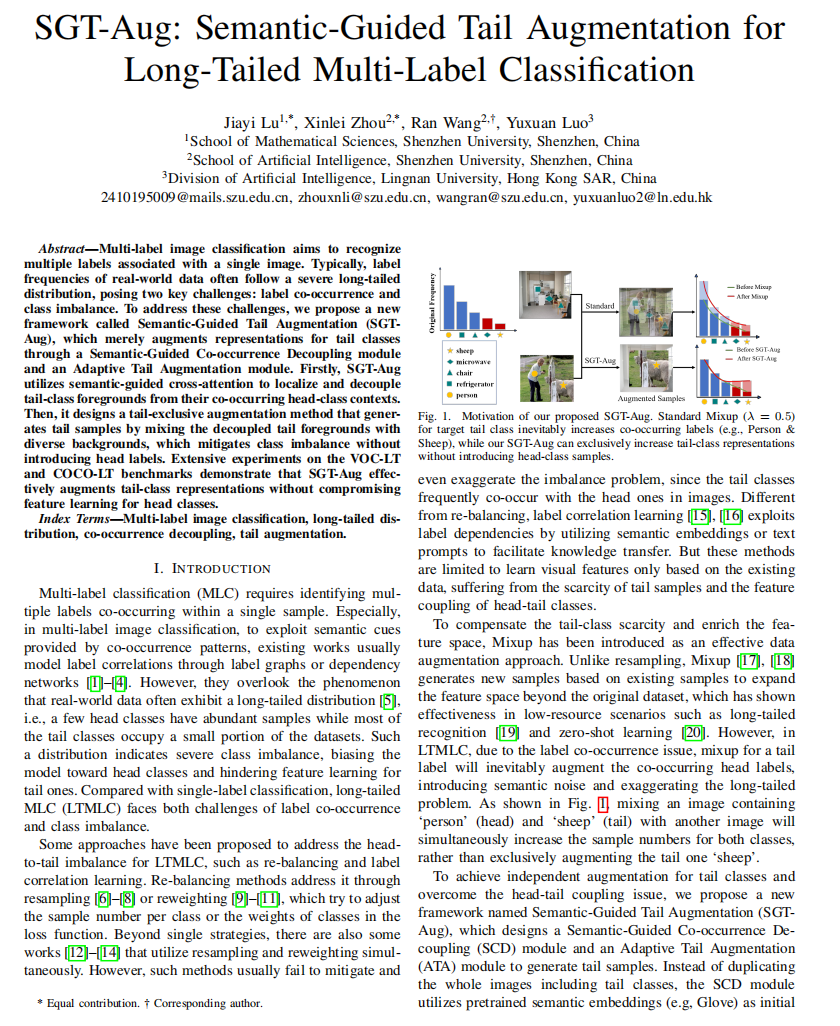 Fig. 1 — t-SNE & Class Activation
P / 01
SGT-Aug · Semantics-Guided Augmentation for Long-Tailed Multi-Label Classification · ICME 2026 (CCF-B, 28.89% acceptance) · 1st author · Accepted, EI indexed by Nov
Inject a pretrained Transformer to model label-wise semantic relations, enabling semantic–vision interaction with a ResNet50 backbone to localize tail-class regions and synthesize targeted augmentations that ease tail-class sparsity.
Problem: in long-tailed multi-label image classification, tail classes are sparse and unevenly distributed — naive training tends to "squeeze them flat".
Approach: ResNet50 backbone + pretrained Transformer for semantic–vision interaction, localizing tail-class-relevant foreground regions. Augmentation is built on those localizations to ease the long-tail imbalance without amplifying it.
Training & results: Linux + PyTorch with single-node multi-GPU DataParallel. Systematic comparison and ablations on VOC-LT / COCO-LT — tail-class accuracy improves by 5.55 / 10.33 percentage points over comparison baselines, and combined with standard classification losses it outperforms several long-tailed multi-label methods.
-
P / 02
SlayQuiz · JD-Driven AI Interview-Training Mini-Program
For job-seekers drowning in dense JDs and fragmented prep paths — decomposes unstructured JDs into role profiles, skill graphs, and tiered training paths, closing the loop from "understand → practice → feedback → review → improve".
System design: sole owner of architecture, technical selection, and prototyping. Decoupled AI generation from deterministic rules (scoring / XP / unlock / stats) and built the closed loop around "JD-driven, personalized interview training".
Stack: Taro + TypeScript mini-program (with H5 cross-end extension) on the front; FastAPI on the back for jobs, question sets, attempts, reports, auth, and KB endpoints, synced via request/response contracts.
AI layer (LangChain + DeepSeek): LangChain orchestrates DeepSeek for JD analysis and on-demand question generation; Bocha / Tavily web search enriches the JD context. JSON Mode + Pydantic Schema parse model output, while question-type quotas, answer-cardinality, knowledge-point binding, and question de-duplication gate non-compliant content.
Generation reliability: async task + fault-tolerance pipeline — status polling, idempotency keys, bounded retries, and tiered recovery handle model timeouts, network errors, JSON parse failures, and rule-check failures. Repeated or malformed questions are repaired in place, avoiding full-set regeneration. Scoring, XP, unlock, and stats are computed by deterministic code; uncertainty is contained at the content-generation step.
Hybrid RAG + learning loop: PDF / Word / URL ingestion, chunking, DashScope Embedding, and Qdrant retrieval with per-user data isolation. Learning layer combines mistake notebooks, variant questions, staged spaced repetition (1/3/7/14 days), and adaptive difficulty across basic / applied / interview tiers — driven by the last-20 accuracy, sample size, and mistake knowledge points — with XP rewards to shape the training path.
Key results: question-generation latency P90 < 15s; in-round semantic duplication 0, cross-round semantic duplication < 5%; full closed loop from "JD understanding → training plan → on-demand generation → instant feedback → mistake review → learning report", with multi-job support and per-user KB isolation.
-
P / 03
Strategem · Multi-Agent Decision-Intelligence Platform
For energy-storage / virtual-power-plant industry research — turning "reading reports" into a runnable pipeline where multi-role agents collaborate to produce traceable decision intelligence.
Deep Research Agent, end-to-end: built on FastAPI + LangGraph + Next.js — supports research-plan confirmation, report generation, section-level rewriting, SSE streaming of task-stage progress, and reference-evidence inspection.
State machine + routing: LangGraph state machine + ResearchState orchestrates intent recognition, plan generation, retrieval, evidence assembly, analysis, and writing. Routing combines "keyword-rule fallback + LLM structured classification" for task triage, low-confidence clarification, and plan confirmation — 96% routing accuracy verified by offline evaluation.
Evidence-coverage driven loop: research flow is controlled by evidence coverage and an iteration budget — when uncovered sub-questions remain and the iteration cap is not yet hit, a supplementary query is generated and fed back to retrieval; otherwise the report is produced. Existing evidence chains are reused for section-level rewrites after report completion.
Dual retrieval + evidence pool: "web search + PostgreSQL + pgvector local KB" dual-channel pipeline; multi-format upload → parse → chunk → DashScope Embedding → pgvector recall. Tenant- and user-scoped data isolation; web sources are ranked by semantic relevance, authority, and freshness, and two-level de-duplication (URL/title + content hash) forms a traceable unified evidence pool.
Evidence chain + audit: four-level "source → evidence → conclusion → citation" chain and audit layer — source whitelist, two-level de-duplication, back-end citation derivation, and structured-output constraints filter illegal or unsupported claims. Conflicting data, missing modules, and structured-output failures are audited, retried, or downgraded; uncovered items are written to the pending-verification queue.
Ownership & outcomes: led the technical design and core pipeline of the Deep Research Agent — LangGraph state machine, ResearchState, dual retrieval + evidence pool, coverage-driven supplementary search, citation derivation + audit markers, and structured-output retry/downgrade. The system supports multi-tenant isolation, section-level rewrites, and a fully traceable citation graph.
-
 P / 04
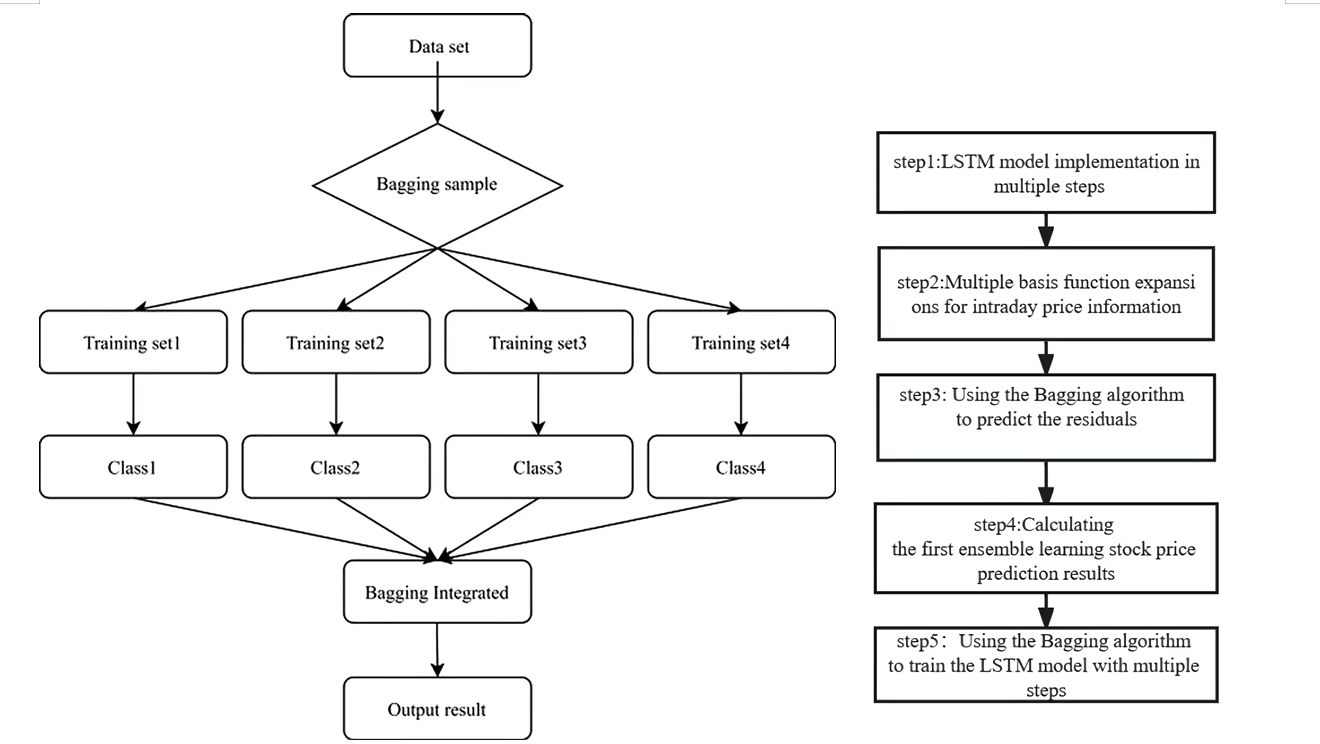
Ensemble Learning for Time-Series Forecasting · CPCI · 1st author
Financial time series are highly nonlinear and noisy — a single LSTM is unstable. The paper boosts robustness with a Bagging + LSTM ensemble.
Feature engineering: EDA on historical stock data to surface open / close / volume signals and craft multi-dimensional features; Fourier and B-spline basis functions for smoothing and feature mapping.
Core model: TensorFlow-based LSTM capturing long-range dependencies.
Ensemble & validation: Bagging constructs diversified training subsets, training multiple LSTMs in parallel. Across multiple forecast horizons, prediction error is significantly lower than the single-LSTM baseline.
-
 P / 05
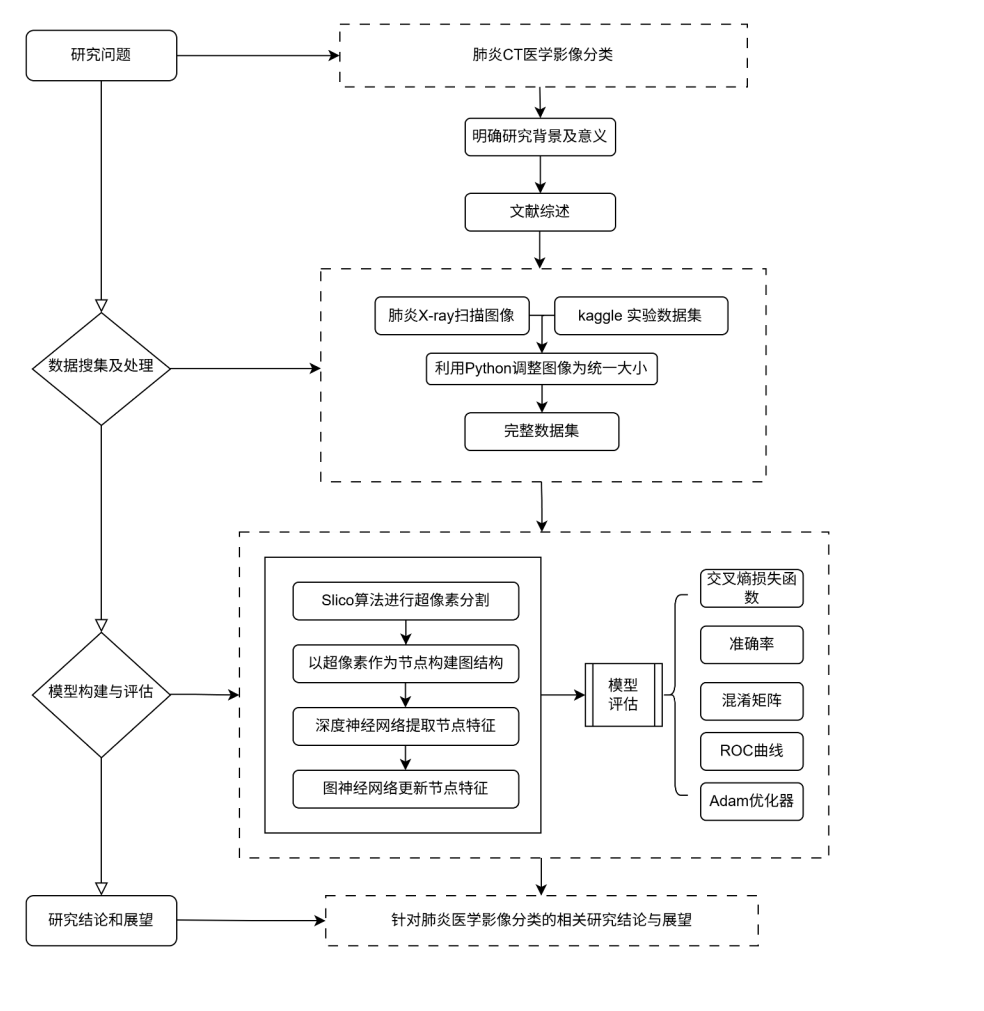
Chest X-Ray Intelligent Recognition & Statistical Modeling · National Statistical Modeling Contest · Team Lead
CNN for local texture + GNN for inter-region relations — pneumonia classification on chest X-rays.
Problem: lesion regions are scattered; local-texture-only models miss spatial-relation cues.
Approach: build a region adjacency graph via SLICO superpixel segmentation, extract per-node features with CNN, then model inter-region relations with GNN — a joint local + relational representation.
Results: systematic experiments & evaluation lifted headline metrics to 92% accuracy, 91.5% sensitivity, 99.5% AUC; as team lead, owned the technical roadmap, experimental design, and coordination.
-
 P / 06
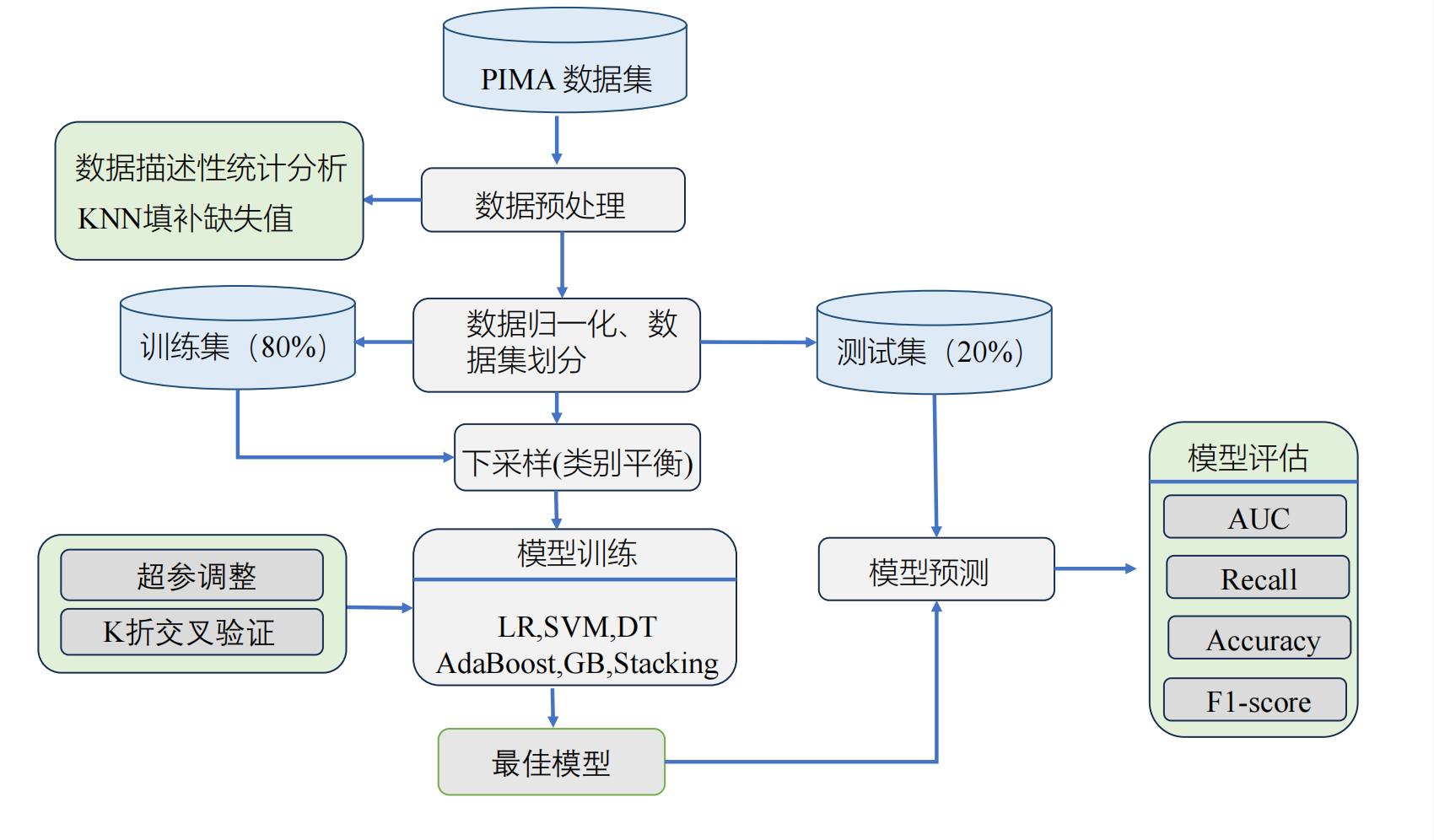
Diabetes Prediction via a Stacking-Ensemble Framework · PIMA · Stacking Ensemble
Stacking LR / SVM / CART with AdaBoost / GBDT — pushed PIMA AUC to 0.96.
Preprocessing: KNN imputation for missing values, then random undersampling to address class imbalance; 80/20 train-test split, with numerical features normalized.
Base learners + boosting: Logistic Regression, SVM, and CART as base classifiers; CART further wrapped into AdaBoost and Gradient Boosting ensembles.
Stacking + hyperparam search: 5-fold cross-validation with Bayesian optimization (Optuna). The fused Stacking model hit AUC 0.96 / Recall 0.84 / Accuracy 0.89 — a 10.3-point AUC lift over the logistic-regression baseline.
Skills
Four buckets: AI Algorithms / ML Engineering / Data Analytics / Certs.
AI Algorithms & Engineering
- LangChain · LangGraph · Agent / multi-Agent orchestration
- RAG · Embedding · vector search (Qdrant / pgvector)
- FastAPI · Docker · Postgres
- Claude / DeepSeek · Prompting · tool-use
- Claude Code / Codex / MCP / Agent Skills for development
Machine Learning & Deep Learning
- PyTorch · TensorFlow (CCF-B / CPCI first-author)
- CNN · GNN · ResNet · Transformer
- LSTM · time-series modeling · Bagging ensembles
- Random forest / clustering / hypothesis testing / regression
- Single-node multi-GPU DataParallel training
Data Analytics & Experiments
- Python · pandas / NumPy / scipy
- SQL · complex queries / window functions / 600K+ prospects in production
- Funnel analysis · attribution · stratified A/B experiments
- 5-dimension user profiling / 1000+ tag taxonomy
- R (coursework)
Certifications & Awards
- 2026 National Scholarship · First-class Academic Scholarship
- Ranked 2 / 20
- CDA Data Analyst · Level I & II
- CDGA Data Governance Engineer
- CET-6 · 537
- CPC member · age 23